
Compare Your Golf Club Distances to PGA Pros
Ever wondered how your driver or 7-iron compares to the average on Tour? Enter your stock carry distances and find out.
See How You Stack Up Against the Pros
Unlike a standard distance calculator, this tool compares your club distances directly against 2023 PGA Tour Trackman Averages. Enter your “Stock” carry below — the distance you reliably hit the ball with a smooth, normal swing, not your absolute maximum drive.
Two golfers with the exact same swing speed can see vastly different results depending on how they deliver the club to the ball. Select your profile below so we can calculate your “Real Average.”
See How You Stack Up Against the Pros
Select your swing profile, then enter your stock carry distance for each club you carry. Leave clubs you don't have blank.
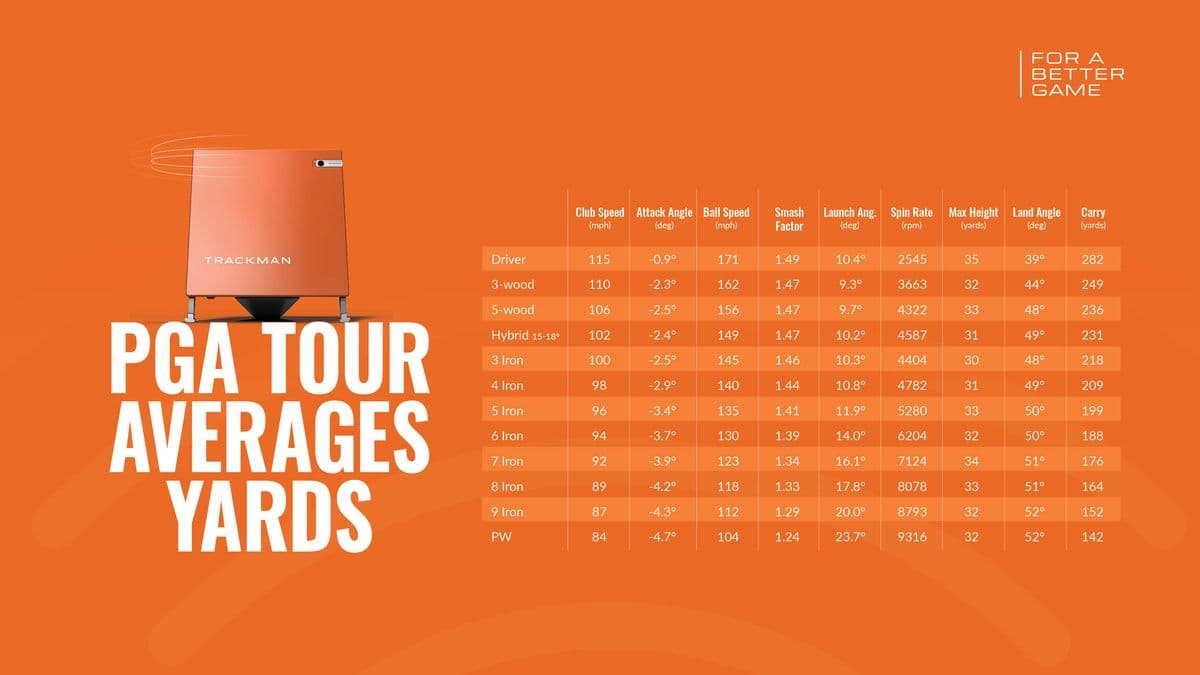
PGA Tour Launch Conditions Reference
Driver
115 mph Club Speed
10.4° Launch Angle
2,545 rpm Spin Rate
7 Iron
92 mph Club Speed
16.1° Launch Angle
7,124 rpm Spin Rate
Pitching Wedge
84 mph Club Speed
23.7° Launch Angle
9,316 rpm Spin Rate
What is Your “Real Average”
Your “Stock” carry is what you believe you hit each club. Your “Real Average” is what you actually hit when we account for the inefficiencies in your swing profile. The tool applies a proprietary efficiency algorithm based on three variables:
Strike Quality (Smash Factor)
Amateur golfers rarely hit the center of the face as consistently as a Pro. A mishit off the toe or heel reduces ball speed significantly. The calculator applies a consistency modifier based on your handicap range to simulate real-world amateur ball striking, rather than PGA Tour perfection.
Ball Flight (Vector Efficiency)
A straight shot travels the shortest distance to the target. If you selected a “Slice” or “Hook,” you are losing forward distance to side-spin. Draws typically produce lower spin and more roll, while fades generate higher spin and steeper landing angles.
Ball Trajectory (Landing Angle)
Shots that “Balloon” (spin too much) or “Run” (launch too low) fail to carry hazards and hold greens. A mid trajectory provides the ideal balance of carry and roll for most golfers.
Understanding Your Gapping Analysis
The tool automatically flags three types of gapping issues in your bag:
Bunching
When two clubs travel roughly the same distance — often the 4-iron and 5-iron. This means you're carrying a redundant club. A golf club fitter can replace “bunched” long irons with Hybrids or High-Loft Fairway Woods that are easier to hit and provide better distance separation.
Gap Alert
Gaps exceeding 18 yards between consecutive clubs indicate you're forced into awkward swing adjustments to cover those in-between yardages. A loft and lie adjustment machine can often fix this in minutes by bending your irons to space them out evenly (e.g., 4° of loft between each club).
Inverted
When a shorter club carries farther than a longer one, it signals a severe equipment mismatch. This is likely a shaft that is too heavy or stiff for that particular club. A professional fitter can diagnose and fix this quickly.
Using This Data to Improve Your Game
Don't Swing Harder, Fit Smarter
A proper driver fitting alone can yield 10–20 yards of carry without changing your swing speed. The right shaft, loft, and head combination optimizes launch conditions to maximize the distance your swing already produces.
Trust Your “Real Average”
Play the “Real Avg” column on course rather than your “Stock” numbers. It feels good to pure a 7-iron 175 yards once, but if your Real Average is 158, playing to 175 will leave you short most of the time. Scoring is about playing the percentages, not the highlight reel.
Fill the Void
If you see a 25-yard gap between your 3-wood and your longest iron, you're missing a club. That gap on the course means forced lay-ups or risky swing adjustments. Identify the missing clubs and work with a fitter to eliminate dead zones in your bag.
Data Source & Methodology
The PGA Tour averages used in this tool are derived from TrackMan's latest 2023 PGA Tour Averages, which tracks real-time performance metrics during tournament play across 40+ events and 200+ players.
All yardages displayed are Carry Distances — the distance the ball travels through the air before landing. Roll is not factored in, giving you a cleaner comparison for approach shots and club selection.
Disclaimer: This tool provides estimates based on averages. External factors like wind, temperature, elevation, and equipment technology will always play a role in exact yardages. The best way to know your real numbers is to book a fitting with a launch monitor.